
Practical Back-End Development Framework for Premium Media NG
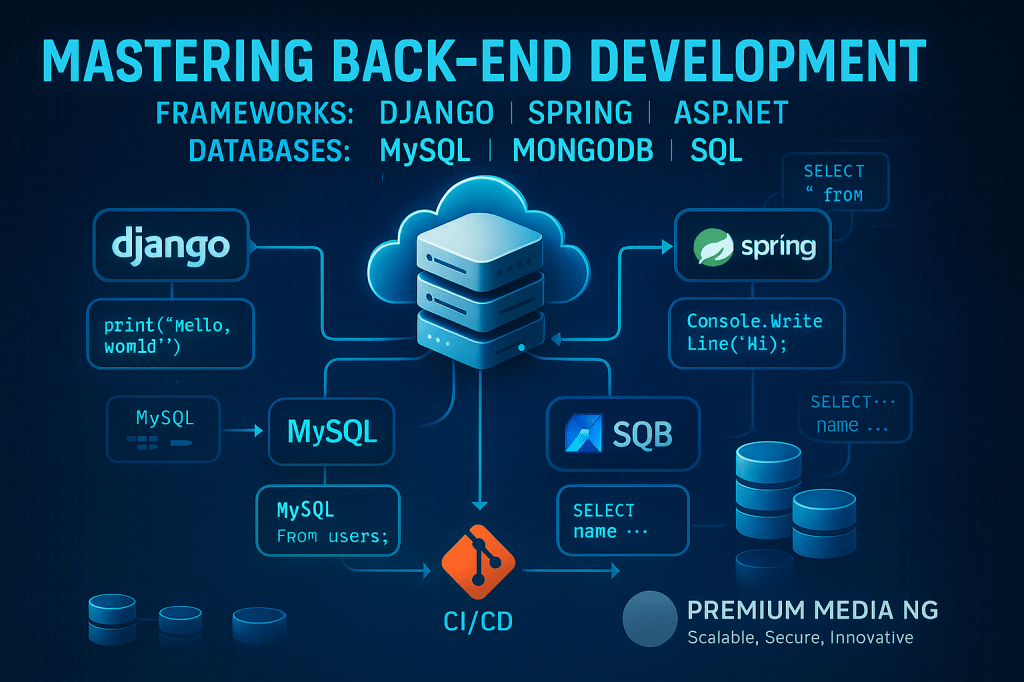
1. Core Technologies & Their Roles
A. Frameworks
- Django (Python):
- Role: Rapid development of secure, scalable web apps (e.g., CMS, analytics dashboards).
- Use Case:
“`python
# Premium Media NG Blog API Example
from django.db import models class Article(models.Model):
title = models.CharField(max_length=200)
content = models.TextField()
published_date = models.DateTimeField(auto_now_add=True)
“` - Why Django? Built-in admin panel, ORM, and SEO-friendly URL routing.
- Spring (Java):
- Role: Enterprise-grade solutions for high-traffic systems (e.g., ad-serving platforms).
- Use Case:
“`java
// Ad Impression Tracker
@RestController
public class AdController {
@Autowired
private AdService adService;@GetMapping("/ads/{id}") public ResponseEntity<Ad> getAd(@PathVariable Long id) { return ResponseEntity.ok(adService.getAd(id)); }}
“` - Why Spring? Microservices support (Spring Boot), robust security (Spring Security).
- ASP.NET (C#):
- Role: High-performance Windows-integrated apps (e.g., internal tools for media rendering).
- Use Case:
csharp // Media Upload Service [HttpPost] public async Task<IActionResult> UploadMedia(IFormFile file) { var filePath = Path.Combine(_config["MediaPath"], file.FileName); using (var stream = new FileStream(filePath, FileMode.Create)) { await file.CopyToAsync(stream); } return Ok(new { filePath }); } - Why ASP.NET? Seamless Azure integration, ideal for Windows-centric environments.
B. Databases
- MySQL:
- Role: Structured data storage (e.g., user accounts, transaction records).
- Schema Example:
sql CREATE TABLE Users ( UserID INT PRIMARY KEY AUTO_INCREMENT, Email VARCHAR(255) UNIQUE, PasswordHash CHAR(60), CreatedAt TIMESTAMP DEFAULT CURRENT_TIMESTAMP );
- MongoDB:
- Role: Unstructured data (e.g., user-generated content, analytics logs).
- Document Example:
json { "_id": ObjectId("507f191e810c19729de860ea"), "articleId": "123", "comments": [ { "user": "Alice", "text": "Great post!" }, { "user": "Bob", "text": "Thanks for this!" } ] }
- SQL:
- Role: Querying relational databases (joins, aggregations).
- Example:
sql SELECT Articles.title, COUNT(Comments.id) AS comment_count FROM Articles LEFT JOIN Comments ON Articles.id = Comments.article_id GROUP BY Articles.id;
C. DevOps & Collaboration
- Git:
- Role: Version control for collaborative coding.
- Workflow:
bash git checkout -b feature/new-cms git commit -m "Add Django CMS models" git push origin feature/new-cms - Tools: GitHub/GitLab for PR reviews, CI/CD pipelines.
- Projects:
- Sample Architecture:
plaintext Client (React) → API Gateway (NGINX) → Django (CMS) / Spring (Analytics) → MySQL/MongoDB ↑ Monitoring (Prometheus/Grafana)
2. Implementation Strategy for Premium Media NG
A. Tech Stack Recommendation
| Component | Tech Choice | Reason |
|---|---|---|
| CMS & Blogs | Django + MySQL | Rapid development, SEO optimization. |
| Ad-Serving Platform | Spring + MongoDB | High concurrency, flexible data modeling. |
| Internal Tools | ASP.NET + SQL Server | Windows integration, enterprise security. |
B. Security Best Practices
- Django: Use
django-allauthfor OAuth2. - Spring: Enable CSRF protection with
Spring Security. - MySQL/MongoDB: Encrypt sensitive fields (e.g., passwords with bcrypt).
C. Scalability Tactics
- Horizontal Scaling: Dockerize apps → Kubernetes orchestration.
- Caching: Redis for frequent queries (e.g., trending articles).
- Load Testing: Locust or JMeter to simulate 10k+ concurrent users.
3. Real-World Project Example
Project: Premium Media NG’s Content Hub
- Django Backend:
- REST APIs for article management.
- Admin panel for editors.
- MySQL: Stores user profiles and articles.
- MongoDB: Tracks user engagement (clicks, shares).
- Git Flow: Feature branches → Code reviews → Automated deployment.
4. Challenges & Solutions
| Challenge | Solution |
|---|---|
| Database latency | Redis caching layer |
| Cross-team collaboration | GitLab CI/CD with granular permissions |
| Securing user data | JWT tokens + HTTPS strict transport |
Next Steps for Premium Media NG:
- Audit current infrastructure against this framework.
- Prioritize Django-based CMS development.
- Train teams on Spring for future microservices.
By aligning these technologies with Premium Media NG’s goals, we ensure scalability, security, and innovation. Let’s code the future! 🚀
Need to adapt this to a specific project? Share your requirements!
 Building Digital Excellence
Leave a comment