
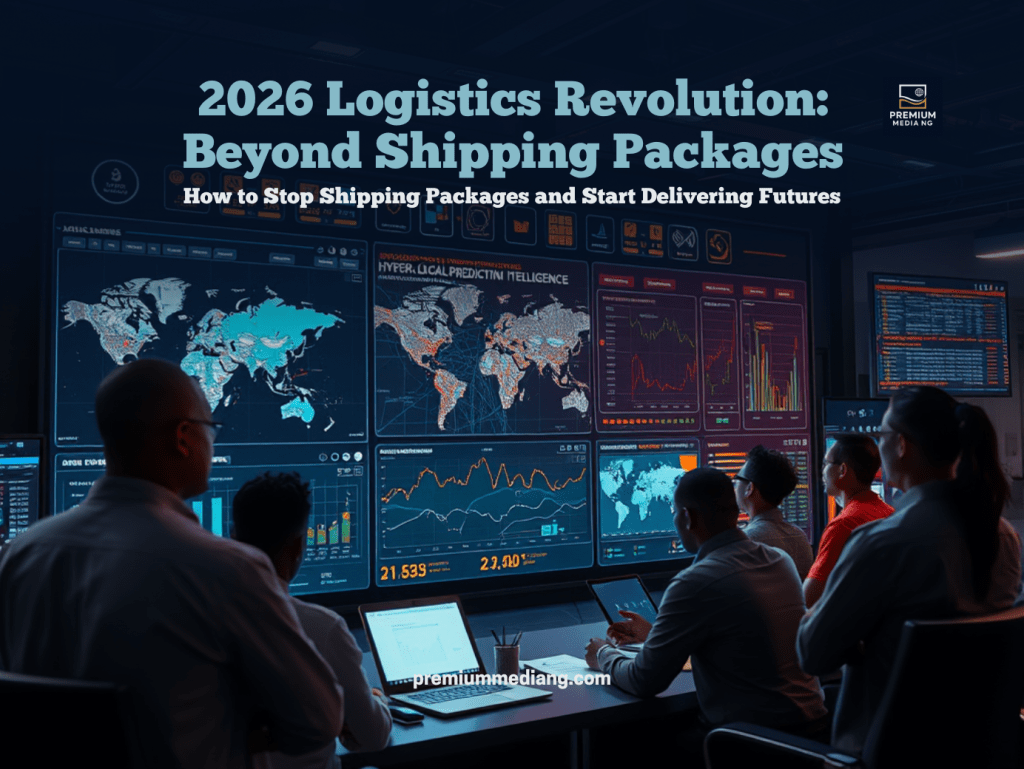
The 2026 Logistics Playbook: How to Stop Shipping Packages and Start Delivering Futures
Introduction: The Midnight Dispatch Call
It’s 11:47 PM. Your operations manager is on the line—again. Another truck is stranded in Apapa gridlock. A major client in Victoria Island is furious about a “lost” package your tracking system shows as delivered. Three riders have quit this week, taking their motorcycles (and your last-mile capacity) to a competitor promising “better tech.”
This isn’t just a bad day. This is the sound of a business model cracking under the weight of 2024’s demands. And 2026 won’t be kinder; it will be decisive.
For the Nigerian logistics founder, a brutal triage is coming. On one path: companies that remain commodity vendors of movement—fighting over shrinking margins, hostage to fuel prices, and invisible to their customers. On the other: a new breed of logistics platforms that command premium rates, attract the best talent, and wield data as their most powerful asset.
This isn’t about working harder. It’s about re-engineering your very operating system. The question for 2026 isn’t “How do we deliver more packages?” It’s: “How do we deliver certainty, intelligence, and growth?”
Here is your non-negotiable blueprint.
🚀 Key Takeaways: Your 2026 Strategic Pillars at a Glance
- Pillar 1: Replace generic maps with Hyper-Local Predictive Intelligence—knowing Lagos ward-by-ward before your wheels roll.
- Pillar 2: Build a Unified Technology Nervous System—your apps must communicate, or you’re losing money with every silence.
- Pillar 3: Engineer a Brand-Driven Customer Experience—transform from a cost center into a growth partner for your clients.
- Pillar 4: Embrace The Green Efficiency Mandate—where sustainability becomes your most powerful cost-control tool.
- Pillar 5: Deploy an AI-Coordinated Command Layer—making real-time decisions at a scale no human team can match.
Pillar 1: Intelligence as Your New Core Infrastructure
Stop Guessing. Start Predicting.
In 2026, the most valuable asset in your fleet won’t be your trucks. It will be your data lake. Traditional GPS tells you where your vehicle is. The 2026 model tells you where it should be, could be, and must avoid.
The 2026 Implementation:
- Integrate Live, Multi-Layered Data Feeds: Go beyond Google Maps. Layer in real-time data from local sources—Lagos State Traffic Management Authority (LASTMA) incident reports, crowd-sourced traffic apps popular in Nigeria, weather APIs predicting the sudden downpours that paralyze Ibadan.
- Build Ward-Level & Time-of-Day Profiles: Does delivery to Maitama on a Monday morning require 45 minutes, but 90 minutes on Friday? Does a specific building in Ikeja GRA always have reception delays? This granular intelligence becomes your routing algorithm’s secret weapon.
- Predictive Analytics for Proactive Operations: Use historical data to predict demand surges (e.g., around holidays, payday weekends, or major events like the Calabar Carnival). Pre-position inventory and allocate resources before the orders flood in.
Disruptive Question: What if you could quote a delivery time to a client in Lekki Phase 1, not based on distance, but on a predictive model analyzing current traffic, planned road closures, and the average wait time at their specific estate gate? That’s 2026 pricing power.
Pillar 2: Your Unified Technology Nervous System
If Your Apps Don’t Talk, Your Business is Having a Stroke.
The patchwork era is over. Using a separate app for dispatch, another for tracking, a WhatsApp group for driver comms, and an Excel sheet for accounting isn’t frugal—it’s financial hemorrhage. Every manual data entry, every missed sync, is money leaking from your operations.
The 2026 Architecture:
- API-First Core Platform: Invest in or build around a central platform where every function connects via APIs. When a delivery is marked complete, it should automatically: update the customer, trigger the invoice, pay the rider (via mobile money integration), and adjust inventory—without human intervention.
- The Single Source of Truth: Your operations dashboard should show a live, unified view: vehicle health (via IoT sensors), rider location, package status, customer satisfaction score, and profitability per trip—all on one screen.
- Cybersecurity as Operational Integrity: In a digitally-dependent fleet, a ransomware attack isn’t an IT issue; it’s a total operational shutdown. Invest in security hygiene as you would in vehicle maintenance.
Table: The Cost of Disconnected Tech vs. The 2026 Stack
| Aspect | The Old Way (Disconnected) | The 2026 Way (Unified Nervous System) |
|---|---|---|
| Driver Payment | Manual calculation, cash disputes, delayed payouts. | Automated, performance-based, instant mobile money payout on job completion. |
| Customer Complaint | Phone calls, endless back-and-forth, reputation damage. | Proactive SMS/email alerts, self-service tracking portal, integrated chat support. |
| Financial Reporting | Week-end data aggregation from 5 sources, errors, delayed insights. | Real-time P&L per client, route, and vehicle. Know your winners and losers instantly. |
Pillar 3: The Brand-Driven Delivery Experience
From Invisible Utility to Memorable Partner.
In 2026, your brand isn’t your logo on a van. It’s the sum of every micro-interaction a customer has with your service. When logistics is a commodity, you compete on price. When logistics is an experience, you compete on value—and you build a moat competitors cannot cross.
The 2026 Brand Blueprint:
- Humanize the Digital Touchpoints: Your tracking page shouldn’t be a sterile FedEx clone. Let the customer see their rider’s first name, a friendly photo, and a clear ETA. Send a delivery confirmation with a “Thank you” note in proper English/Pidgin.
- Turn Riders into Brand Ambassadors: Invest in their appearance (clean, branded uniforms), equip them with power banks and polite scripts, and incentivize positive customer feedback. The rider at the door is your most important marketing channel.
- Become a Growth Lever for Your Clients: Offer e-commerce companies branded tracking pages that match their website’s look and feel. Provide them with data insights: “Your customers in Port Harcourt have the highest satisfaction scores.” You’re no longer a vendor; you’re a partner in their customer experience.
Pillar 4: The Green Efficiency Engine
Sustainability is Your Ultimate Cost-Control Strategy.
Forget “going green” as a PR stunt. For the 2026 logistics leader, it’s the most sophisticated operational and financial hedge available.
The 2026 Efficiency Leap:
- The Electric & Hybrid Transition: Begin pilot programs with electric motorcycles and hybrid vehicles for urban routes. Calculate the TCO: while the upfront cost is higher, the savings on fuel (subject to volatile subsidies and forex) and maintenance are transformative. It’s a capital investment that pays for itself in predictability.
- Route Optimization = Fuel Optimization: Every kilometer saved isn’t just time—it’s direct cash preserved. Advanced routing algorithms that minimize left turns, idle time, and empty return trips have a direct, measurable ROI.
- The Talent & Client Magnet: The next generation of top talent wants to work for forward-thinking companies. Major corporates are under ESG mandates. Your sustainability story becomes a powerful recruitment and B2B sales tool.
Pillar 5: The Autonomous Coordination Layer
Your AI Co-Pilot is Waiting.
Artificial Intelligence isn’t about replacing your dispatch team. It’s about giving them superpowers.
The 2026 Command Center:
- Dynamic, Self-Optimizing Routing: Instead of a human planner manually adjusting for a broken-down truck, an AI model instantly re-optimizes the entire day’s routes for the remaining fleet in seconds, minimizing disruption.
- Predictive Maintenance: IoT sensors on vehicles predict a alternator failure next week and schedule maintenance proactively, avoiding a catastrophic breakdown during a critical delivery.
- Intelligent Customer Communication: AI handles the 80% of routine customer inquiries (“Where is my package?”) via smart chatbots, freeing your human team to handle the 20% of complex, high-value issues that build relationships.
- Dynamic Pricing Models: For on-demand services, AI can adjust pricing in real-time based on demand surge, traffic conditions, and priority level, maximizing yield per trip.
Conclusion: The Founder’s Choice – Commodity or Sovereign?
The path to 2026 is not paved with incremental improvements. Adding two more bikes or negotiating a slightly better fuel discount is rearranging deck chairs on a ship that’s being out-engineered.
The coming divide will be between Logistics Commodities and Logistics Sovereigns.
The Commodity fights for scraps, visible only when something goes wrong. The Sovereign builds an impregnable ecosystem—of predictive data, seamless technology, beloved brand experience, resilient efficiency, and intelligent automation. They don’t just respond to the market; they shape it.
Your window to choose is open, but it is closing.
This blueprint is the map. But execution is the territory. The complexity of weaving hyper-local data APIs into your operations, architecting a unified tech stack, and training AI models on your unique business logic is non-trivial. It requires a strategic partner who sees the destination and knows the terrain.
Ready to Build Your 2026 Operating System?
This is where theory meets the road. If you’re ready to move from being a vendor of movement to a sovereign of supply chain intelligence, your first strategic step is a conversation.
We help ambitious Nigerian logistics founders engineer this exact future.
📞 Claim Your Strategy Session: Let’s diagnose your biggest bottleneck and map your 2026 pivot. Call +234 806 041 8202.
🌍 Audit Your Readiness: Dive deeper into our strategic frameworks at premiummediang.com.
📲 Send Us Your Biggest Bottleneck: DM us @premiummediang with your #1 operational headache. We’ll send you a actionable insight.
Stop shipping packages. Start delivering futures. The 2026 leader is being built today. Will it be you?
About Premium Media NG: We are the strategic growth partner for B2B and tech companies in Nigeria’s digital economy. We don’t just make marketing; we build market-defining category leadership by blending deep audience insight, technical precision, and brand authority.
 Building Digital Excellence
Leave a comment