
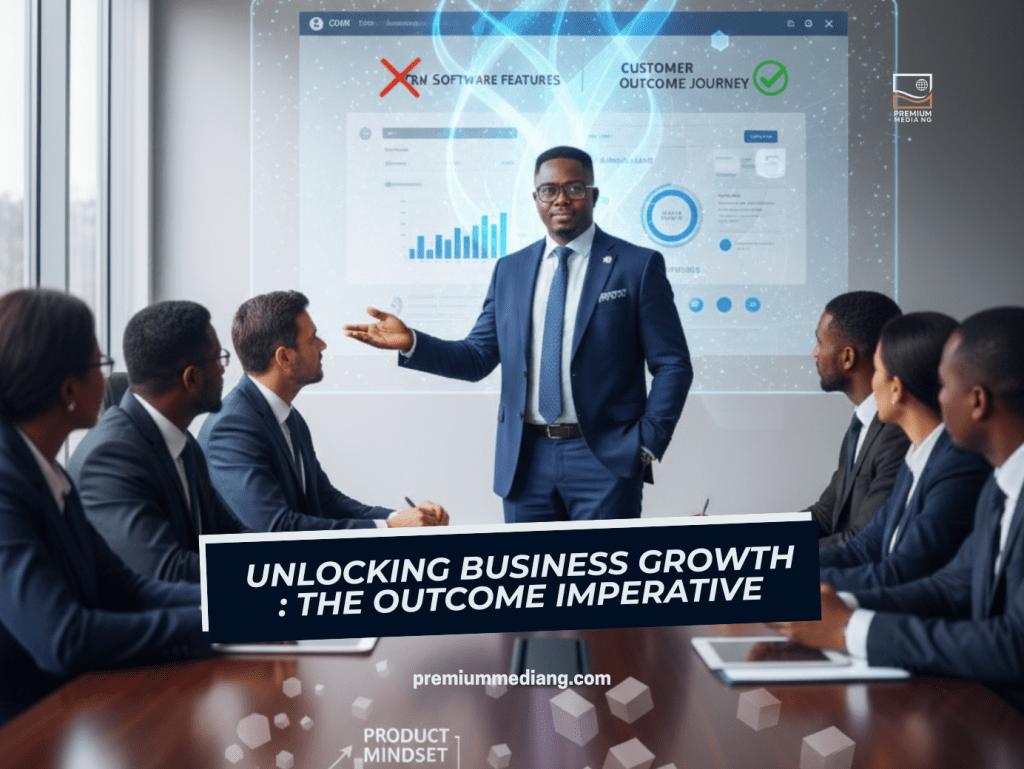
The Outcome Imperative: Why Smart Leaders Buy Results, Not Software
Imagine this: A brilliant business owner—let’s call him Tunde—stood before his board, pitching a significant investment. He wasn’t asking for a new factory or a fleet of trucks. He was requesting budget approval for a “custom CRM and customer portal.”
His pitch was full of impressive features: real-time notifications, a sleek dashboard, integrated payment gateways. The board approved it. Twelve months and a considerable sum of money later, they had a product. It was technically sound, visually appealing, and functionally complete.
Yet, Tunde sat in his office feeling a hollow sense of disappointment. Customer satisfaction scores were flat. Operational costs hadn’t decreased. Revenue growth continued its same, steady pace. The software worked, but the business hadn’t changed. He had bought a product, but he hadn’t bought the outcome he truly needed.
If this story feels familiar, you’re not alone. This is the most common and costly mistake in digital investment. Today, the most visionary leaders are making a fundamental paradigm shift. They understand a core truth:
People don’t buy products; they buy outcomes.
This isn’t just a marketing slogan. It’s the new rule of strategic growth. Let’s explore why this shift is non-negotiable and how you can apply it to secure your own competitive advantage.
The Costly Divide: Product Mindset vs. Outcome Mindset
The chasm between these two approaches isn’t just philosophical—it’s financial, operational, and strategic.
| The Product Mindset (The Cost Center) | The Outcome Mindset (The Growth Engine) |
|---|---|
| Focus: Features, specifications, hourly rates. | Focus: Business metrics, user behavior, ROI. |
| Question: “Can you build this feature list?” | Question: “How will this change my business?” |
| Relationship: Transactional vendor-client. | Relationship: Strategic partnership. |
| Success Metric: On-time, on-budget delivery of the spec. | Success Metric: Measurable improvement in a key business indicator (e.g., revenue, efficiency, retention). |
| Risk: High. The product may be perfect but irrelevant. | Risk: Managed. Every step is tied to a validated business goal. |
The Product Mindset leads to solutions in search of a problem. The Outcome Mindset starts with the problem and crafts the precise solution.
Proof in Practice: From Feature List to Growth Engine
Let’s move from theory to tangible proof. This anonymized case study illustrates the transformative power of the Outcome Mindset, powered by our Premium Path methodology.
Client Profile: “Logistik Naija,” a growing Nigerian logistics company facing intense competition and operational strain.
- The Surface Problem: Manual dispatch tracking, lost paper invoices, and customer complaints about delivery updates.
- Their Initial Request (The Product Ask): “We need a driver tracking dashboard and a customer portal for tracking numbers.”
Phase 1: Discover – Reframing the Ask
Instead of quoting for the dashboard and portal, we initiated a Discovery Sprint. We spent two weeks embedded with their team, analysing data, and interviewing drivers and customers. We reframed their entire project around three business outcomes:
- Revenue Growth: Increase customer retention (and lifetime value) by improving service reliability.
- Operational Efficiency: Reduce administrative overhead and fuel costs by optimizing routes.
- Market Positioning: Become known as the most reliable and transparent logistics provider in their region.
The New, Outcome-Driven Goal: “Increase on-time delivery rate by 25%, reduce route planning and invoicing overhead by 20 hours per week, and improve customer retention by 18% within 12 months.”
Phases 2 & 3: Build & Launch – Executing Towards Metrics
We didn’t just build a dashboard and portal. We built an Integrated Logistics Orchestration Platform.
- The “dashboard” became an AI-assisted route optimizer that considered traffic, weather, and delivery windows, directly targeting the “on-time delivery” metric.
- The “customer portal” became a proactive communication suite that sent automated, personalized status updates, directly targeting “customer retention.”
- We added an automated invoicing module that generated and sent invoices upon delivery confirmation, directly attacking “administrative overhead.”
Phase 4: Scale – Measuring the Outcome
Nine months post-launch, the results were not about software uptime, but business uptick:
- On-time deliveries improved by 32%.
- Administrative time spent on dispatch and invoicing reduced by 25 hours/week.
- Customer churn decreased by 22%.
- An unexpected outcome: Drivers reported higher job satisfaction due to clearer routes.
The technology was the vehicle, but the business outcomes were the destination.
Your Blueprint: The Outcome Canvas™
Inspired by proven methodologies and our work with clients like Logistik Naija, we’ve codified our approach into a simple but powerful tool: The Premium Media NG Outcome Canvas™. This is how we translate vision into measurable reality.
The canvas forces clarity on five key dimensions before any code is written:
- The Strategic Anchor: What is the core business ambition? (e.g., “Become the market leader in premium logistics.”)
- The Metric That Matters: What single, measurable key performance indicator (KPI) will prove we’ve succeeded? (e.g., “Customer Retention Rate.”)
- The Human Element: Who are the users (internal and external), and what behavior do we need to change? (e.g., “Customers feel informed and valued; dispatchers make data-driven decisions.”)
- The Solution Hypothesis: What functionality will most effectively drive the metric and enable the new behavior? (This is where “features” finally appear, but as hypotheses, not demands.)
- The Investment & Return: What is the total investment (time, capital), and what is the expected tangible return (ROI, cost savings, revenue increase)?
This canvas becomes the living, breathing contract of the partnership, ensuring every sprint and every feature ties directly back to your business North Star.
The Owner’s Diagnostic: 5 Questions to Ask Before You Build
Before you invest another naira in technology, ask these questions to yourself and any potential partner:
- What key business metric (KPI) will this change, and by how much? (If the answer is “we don’t know,” stop. Go back to discovery.)
- How will we measure its success in 3, 6, and 12 months? (Demand a clear analytics and reporting plan.)
- Beyond the software, what changes in our team’s workflow or customer experience are required to realize the value? (Technology enables change; it doesn’t guarantee it.)
- What does “done” look like for the business, not just for the project? (“Done” is not a launched app. “Done” is a achieved metric.)
- Are we prepared to partner, not just purchase? (Outcome-driven development requires continuous collaboration, not a “set and forget” specification.)
If a development team cannot engage deeply with these questions, they are selling you a product, not a partnership for outcomes.
From Insight to Action: Your Next Step
Understanding the “Outcome Imperative” is the first step. Implementing it requires a partner who speaks the language of business and technology. This is where the conversation begins.
At Premium Media NG, we are not just software developers; we are business outcome architects. Our entire Premium Path—Discover, Build, Launch, Scale—is designed to systematically de-risk your investment and laser-focus it on growth.
Ready to transform your product idea into a guaranteed-result roadmap?
Book Your Outcome Mapping Session. This is a free, 90-minute strategic workshop with our founders. We’ll apply the principles of the Outcome Canvas™ to your biggest business challenge and map the first steps of your path to a measurable result.
📞 Let’s talk: +234 806 041 8202
🌍 Visit: premiummediang.com
📲 DM us: @premiummediang
Decoding the Jargon: A Business Owner’s Glossary
- Agile Development: A partnership method where we build in short, visible cycles (sprints), allowing you to adjust the plan based on real learning and changing business needs, minimizing risk.
- Sprint: A 2-week period of focused work resulting in a working, testable piece of software, keeping progress tangible and investment controlled.
- Scalability: Building your solution on a foundation that won’t crack under the weight of your own success (e.g., handling 10x users without a re-write).
- API: A digital “connector” that allows your software to talk seamlessly with other tools (like payment gateways or SMS services), creating a unified system.
Premium Media NG is a strategic software development partner for forward-thinking Nigerian and African businesses. We build bespoke web and mobile applications that are engineered for one purpose: to deliver measurable, transformative business outcomes.
 Building Digital Excellence
Leave a comment