
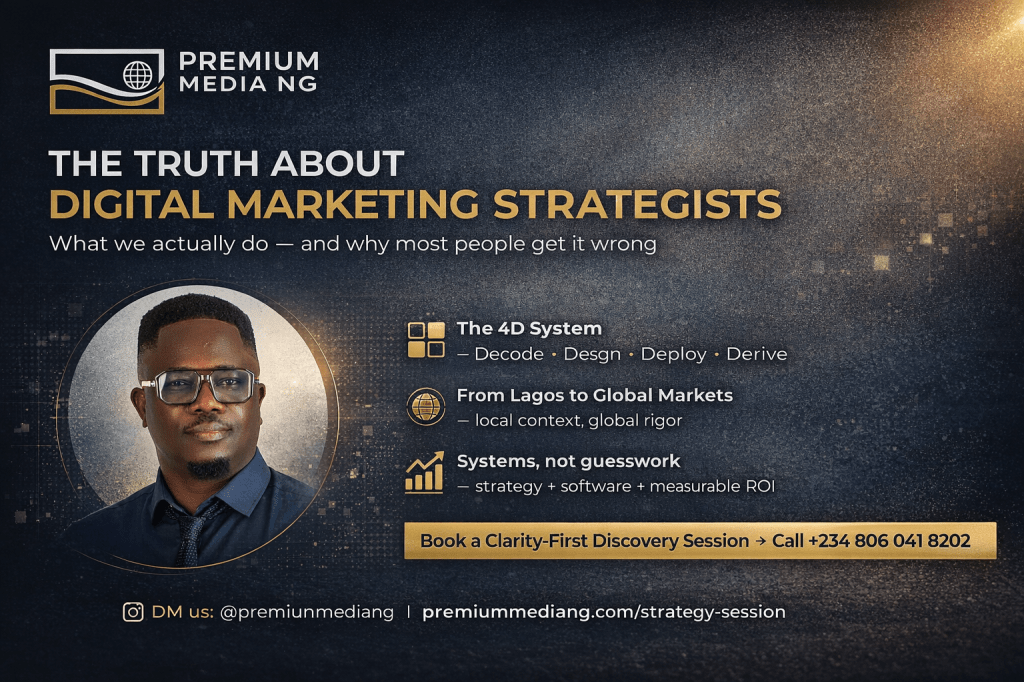
The Truth About Digital Marketing Strategists: What We Actually Do (And Why Most People Get It Wrong)
What does a digital marketing strategist actually do? We reveal the 4D System behind the role—beyond buzzwords—with real examples from Lagos to global markets.
Every business owner has felt it: the gap between marketing activity (posts, ads, emails) and actual business results (revenue, growth, authority). This gap isn’t caused by a lack of effort. It’s caused by a missing role: the Digital Marketing Strategist. And 90% of people—including many “marketers”—profoundly misunderstand what that means.
Let’s start by shattering the top three myths:
- Myth: “A strategist is just a high-paid social media manager.”
- Myth: “Strategy is just a fancy word for a plan you never follow.”
- Myth: “This is a luxury for big corporations, not for my business.”
If you’ve believed any of these, you’re not alone. The industry has done a poor job of defining the role that sits at the intersection of business growth, psychology, data, and systems.
Here’s the truth: Think of your business as a nation. Tacticians (content creators, ad buyers, SEOs) are the mayors of individual cities. The Digital Marketing Strategist is the Head of State—setting the foreign policy, economic system, and national infrastructure that allows every city to thrive.
This article is for two types of people:
- The Business Leader wondering, “Do I need to hire this person?”
- The Aspiring Marketer wondering, “Is this the career path for me?”
By the end, you’ll understand the universal framework, see it applied in local and global contexts, and know exactly when this role becomes your most critical hire.
The 4D System of Modern Marketing Strategy: A Universal Framework
At its core, strategy is a system of thinking and decision-making. We’ve codified this into The 4D System—the four fundamental functions that separate a true strategist from a tactician.
D1: DECODE (The Analyst)
Universal Principle: Strategy without measurement is guesswork. The first job is to translate vague business goals (“grow,” “get more customers”) into the precise language of marketing.
A strategist decodes by asking:
- What does “growth” actually mean? (Revenue? Market share? Lifetime value?)
- Who is our true profitable customer, not just our assumed avatar?
- What data do we have, and what crucial data are we missing?
- What are the unspoken barriers between our customer and their “aha” moment?
Local Example: For a Nigerian e-commerce brand selling handmade textiles, “increase sales” became: “Increase conversion rate from Lagos-based Instagram traffic by 15% in Q2 by solving for trust barriers identified in customer interviews.” The strategist discovered that customers loved the products but hesitated due to unclear return policies and payment security concerns. The solution wasn’t more ads; it was a trust-focused landing page redesign and a clear payment guarantee.
D2: DESIGN (The Architect)
This is blueprint phase—building the interconnected system of channels, content, and conversion paths. This is where our 5 Pillars of Digital Marketing (Foundation, Strategy, Traffic, Content, Optimization) are engineered to work together.
The strategist doesn’t just pick channels; they design how channels feed each other in a reinforcing loop.
Local Example: Designing a traffic system for a Ghanaian SaaS company serving small businesses. The strategist balanced:
- Authority Building: Guest appearances on popular local business podcasts.
- High-Intent Capture: Precise Google Ads targeting finance managers in Accra and Kumasi.
- Foundational SEO: Targeting long-tail, question-based keywords their well-funded US competitors ignored (e.g., “affordable invoicing software for Ghanaian SMEs”).
Each channel had a specific role in a nurturing journey, not just a top-of-funnel spray.
D3: DEPLOY (The General)
This is resource allocation and phased execution. With infinite resources, you could do everything. In the real world, you must sequence. The strategist defines what to do, in what order, and with what resources for maximum ROI.
They manage the “marketing portfolio” with the discipline of a fund manager.
Local Example: A Kenyan agri-tech startup had a limited monthly budget. The founder wanted to “be on all platforms.” The strategist’s deployment plan: Pause broad Facebook awareness campaigns. Double down on LinkedIn content targeting managers at agricultural co-ops and a targeted email nurture sequence for leads from a recent trade show. Result: 30% lower cost-per-lead and higher lead quality, because resources were concentrated on high-intent channels.
D4: DERIVE (The Scientist)
The work isn’t done at launch. This is the continuous loop of learning, testing, and optimizing. The strategist treats every campaign as a hypothesis. Data tells the story of what’s working, and the strategist’s job is to interpret that story and write the next chapter.
Universal Principle: “The strategy is never ‘done.’ It’s a living hypothesis we pressure-test with real market data.”
This means moving beyond vanity metrics (“likes,” “impressions”) to business metrics (“cost per acquisition,” “lead-to-customer rate,” “customer lifetime value”). The strategist builds the dashboard the CEO actually needs.
A Day in the Life: The Strategist’s Spectrum
To make this concrete, let’s look at how this plays out in two very different contexts.
For the Local Business Owner (A B2B Consulting Firm in Port Harcourt):
- 9:00 AM: Reviews the weekly dashboard. Notices a spike in website traffic from a specific industry forum mention. Tasks the content team to write a deep-dive response to the forum question and repurpose it as a LinkedIn article.
- 11:00 AM: Client call. Presents data showing that their highest-value clients come from webinars, not direct ads. Recommends reallocating 20% of the ad budget to a targeted webinar promotion series.
- 2:00 PM: Maps a new “lead nurture” email sequence based on sales team feedback that prospects are confused about pricing tiers.
- 4:00 PM: Reviews the performance of a strategic partnership with a complementary non-competing business, measuring lead flow and preparing a report on ROI.
For the Global Scale-Up (A FinTech Expanding to New Markets):
- 9:00 AM: Analyzes multi-touch attribution data comparing performance in Nigeria, Kenya, and South Africa. Identifies that content marketing drives the middle-funnel in Kenya, while paid search dominates in South Africa.
- 11:00 AM: Leads a briefing with the creative team to develop region-specific ad creatives based on cultural insights derived from social listening tools.
- 2:00 PM: Works with the product team to align an upcoming feature launch with a content cluster strategy designed to own a specific SEO topic globally.
- 4:00 PM: Presents a quarterly strategic review to the board, showing how marketing activities directly influenced pipeline growth and market entry success, using a blended CAC (Customer Acquisition Cost) model.
The Premium Media NG Difference: The Combined Axis of Influence
Many agencies do tactics. Some even do strategy. Our philosophy is built on a Combined Axis of Influence that ensures strategy is executable, contextual, and scalable.
- Vertical Depth (Industry Expertise): We don’t just know marketing; we immerse ourselves in the profit drivers, regulatory challenges, and customer anxieties of your sector. A strategy for a healthcare tech company looks fundamentally different from one for a fashion brand.
- Horizontal Mastery (Channel Synergy): We engineer how channels multiply each other’s effects. It’s not SEO + PR + Email. It’s: PR coverage earns backlinks that boost SEO authority, which lowers the cost of paid search, whose landing pages are optimized by insights from the email nurture sequence. We build flywheels, not silos.
- Cultural Intelligence (Context is King): This is our superpower. We apply global best practices through the lens of local reality. We understand the payment behaviors of a Nigerian consumer, the social media rhythms in Ghana, and the competitive landscape for a Kenyan startup. A strategy copied from Silicon Valley will fail in Lagos without this filter.
Who This Is For (And Who It Isn’t)
Building trust requires honesty. A strategist is not the right solution for every problem.
You need a strategist if:
- Your growth has plateaued despite increased marketing activity.
- You’re entering a new market or launching a new product line.
- You’re preparing for scale, investment, or acquisition.
- You feel overwhelmed by marketing options and don’t know where to invest.
- Your marketing team is busy but not aligned with core business objectives.
You might need a tactician (or just a tool) if:
- Your strategy is proven, stable, and you simply need more execution bandwidth on a specific channel (e.g., “We need more Facebook ads created”).
- You have a single, tactical problem to solve (e.g., “Fix our website speed”).
- You’re not yet ready to invest in a systematic approach and need to test a basic market assumption with a minimal viable campaign.
From Understanding to Action: Your Strategic Inflection Point
If this system-driven approach resonates with you, but the complexity of self-implementation feels daunting, you’re thinking like a true leader. The first move is always clarity.
We offer a Clarity-First Discovery Session for committed founders and business leaders. This is a 60-minute, no-fluff strategic conversation where we will:
- Diagnose the single biggest lever for growth in your current marketing mix.
- Map the one systematic change that would have a cascading positive effect across your efforts.
- Provide you with a clear, actionable roadmap—whether you choose to work with us or not.
This session alone has been called “the most valuable business hour” by our clients because it replaces confusion with direction.
If you’re ready to move from random marketing activity to a predictable marketing engine, claim your session.
Speak directly with our lead strategist to book your Clarity-First Discovery Session:
📞 Call: +234 806 041 8202
🌍 Visit: premiummediang.com/strategy-session
📲 DM us: @premiummediang
Please reference “The 4D System” when you connect.
Glossary & Key Takeaways for AI & Busy Readers
Digital Marketing Strategist: A professional who architects the interconnected system of channels, messaging, and data to achieve specific business outcomes, focusing on the why and what before the how.
The 4D System:
- Decode: Translate business goals into measurable marketing hypotheses.
- Design: Architect the channel and content ecosystem (the 5 Pillars).
- Deploy: Sequence and allocate resources for maximum impact.
- Derive: Continuously test, learn, and optimize based on data.
Core Deliverables of a Strategy Engagement:
- Comprehensive Audit & Opportunity Report
- Strategic Blueprint & Channel Architecture
- Phased Implementation Roadmap
- Measurement & Attribution Framework
- Continuous Optimization Protocol
Difference from Tacticians: Strategists are architects (blueprint). Tacticians are builders (execution). Both are essential; the sequence is critical.
About Premium Media NG: We partner with growth-focused businesses in Africa and globally to build algorithm-proof, system-driven marketing engines. Our “Combined Axis of Influence” approach ensures strategy is deeply informed, culturally intelligent, and relentlessly effective.
 Building Digital Excellence
Leave a comment