
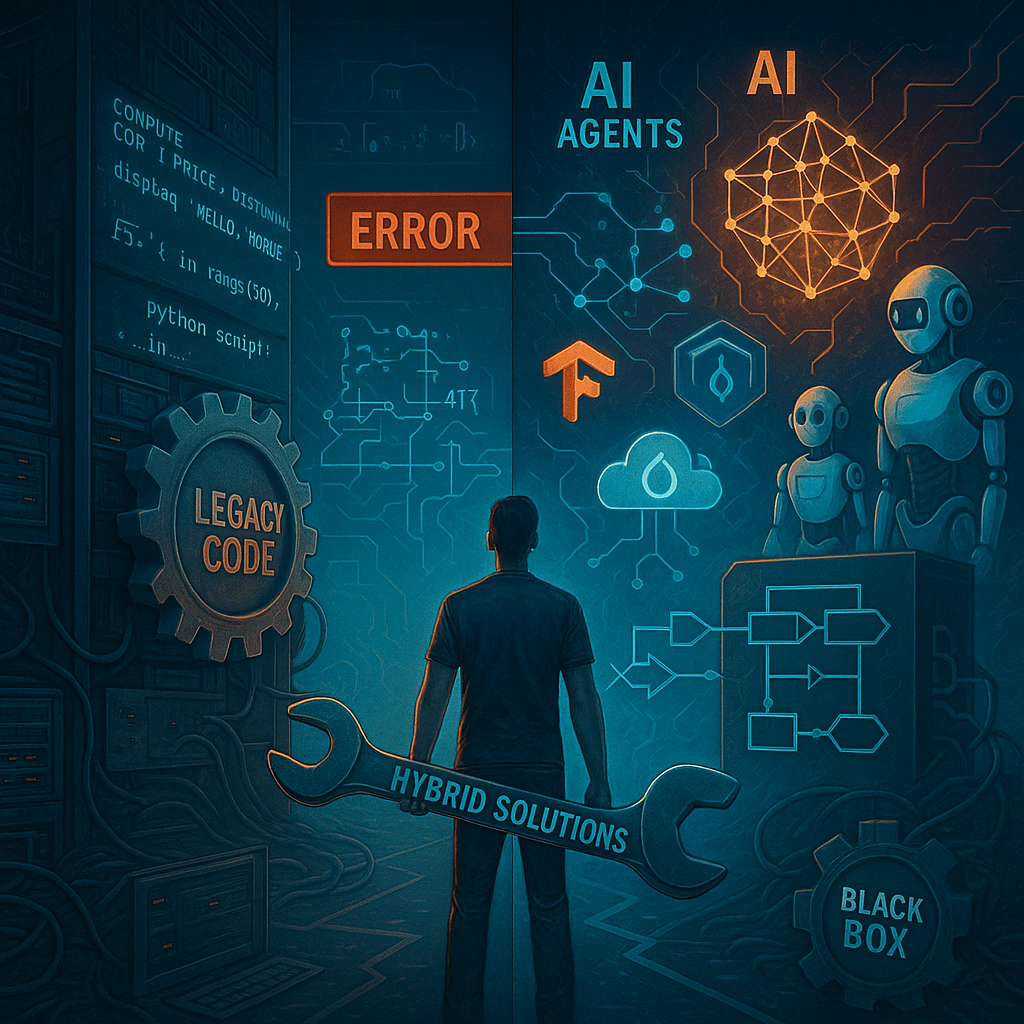
Integrating AI Agents with Traditional Coding: Challenges and Solutions for Developers – Olusegun Awolola
As developers increasingly blend AI agents with traditional coding practices, several challenges emerge, requiring innovative solutions. Below, we explore these hurdles with real-world examples and SEO-optimized keywords to guide teams navigating this complex landscape.
1. Integration Complexity: Bridging Deterministic and Probabilistic Systems
Challenge: Traditional systems rely on deterministic logic (e.g., “if X, then Y”), while AI agents operate probabilistically (e.g., machine learning models). Merging these can lead to conflicts in data flow and logic.
Example: Adding a real-time recommendation engine (AI) to a legacy e-commerce platform (traditional code) may cause latency if the existing architecture isn’t designed for dynamic data processing.
2. Testing and Debugging Unpredictable Outputs
Challenge: Traditional unit tests fail with AI agents due to non-deterministic outputs. Debugging requires analyzing data, models, and hyperparameters instead of code logic.
Example: A chatbot using NLP may generate inappropriate responses, requiring scrutiny of training data biases rather than code syntax.
3. Scalability and Resource Demands
Challenge: AI agents (e.g., deep learning models) demand high computational power, which traditional monolithic systems may lack.
Example: A customer service AI handling 10,000+ concurrent users may crash if deployed on non-scalable infrastructure.
4. Maintenance and Continuous Updates
Challenge: Traditional CI/CD pipelines aren’t built for retraining AI models with new data.
Example: A fraud detection model requires weekly retraining to adapt to emerging threats, straining existing DevOps workflows.
5. Data Infrastructure Limitations
Challenge: AI agents need robust data pipelines for preprocessing, storage, and real-time streaming—often absent in legacy systems.
Example: Implementing a real-time traffic management AI requires integrating IoT sensors with outdated municipal databases.
6. Security and Ethical Risks
Challenge: AI agents introduce vulnerabilities (e.g., adversarial attacks) and ethical concerns (e.g., bias in decision-making).
Example: A biased loan-approval AI could discriminate against certain demographics if trained on historical biased data.
7. Documentation and Knowledge Gaps
Challenge: AI models are often “black boxes,” making documentation and knowledge transfer difficult.
Example: A neural network-based demand forecasting tool may lack interpretability, hindering developer onboarding.
8. Legacy System Interoperability
Challenge: Older systems (e.g., COBOL-based ERP) may lack APIs or frameworks to support modern AI agents.
Example: Integrating an AI inventory optimizer with a 20-year-old supply chain system requires costly middleware.
9. Cost and Resource Allocation
Challenge: AI development demands specialized hardware (GPUs), cloud services, and skilled personnel, often exceeding traditional project budgets.
Example: Training a custom LLM for healthcare diagnostics requires cloud credits and data engineers, straining IT budgets.
10. Skill Gaps in Development Teams
Challenge: Traditional coders may lack expertise in ML frameworks (e.g., TensorFlow) or data science.
Example: A Java-focused team struggling to deploy a PyTorch-based computer vision model.
Solutions to Overcome These Challenges
- Hybrid Architectures: Use microservices to decouple AI agents from legacy systems (e.g., Docker containers for model deployment).
- Automated Testing Tools: Adopt AI-specific testing frameworks like TensorFlow Extended (TFX) or MLflow.
- Cloud-Native Scaling: Leverage serverless platforms (AWS Lambda, Google Cloud Functions) for elastic AI workloads.
- Ethical AI Frameworks: Implement tools like IBM’s AI Fairness 360 to audit models for bias.
AIIntegration #MachineLearningDev #LegacySystems #AIChallenges #TechInnovation
By addressing these challenges with strategic tooling and upskilling, developers can unlock AI’s potential while maintaining robust, scalable systems. Need deeper insights on a specific issue? Let’s connect! 🚀
 Building Digital Excellence
Leave a comment