
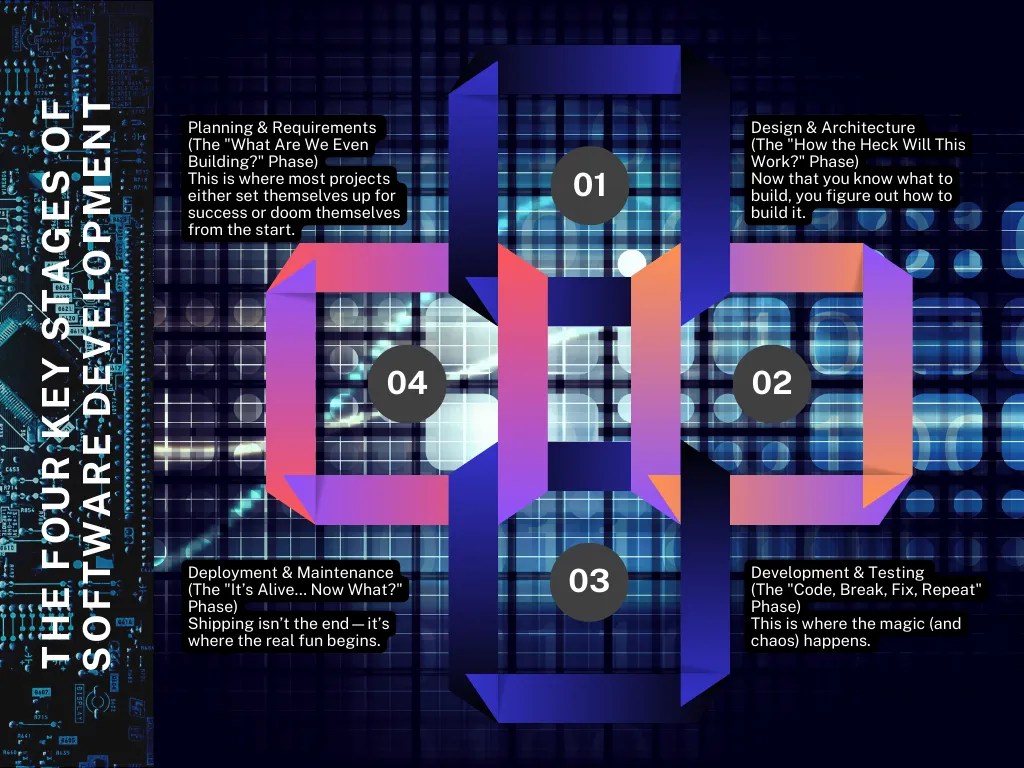
The Four Key Stages of Software Development
As a seasoned software developer, I’ve been through the grind of building software from scratch countless times. Let me break down the four key stages of software development in a way that reflects real-world experience — no corporate fluff, just the raw truth of how things actually get built.
1. Planning & Requirements (The “What Are We Even Building?” Phase)
This is where most projects either set themselves up for success or doom themselves from the start.
– What happens here?
— You sit with stakeholders (clients, product managers, or even just your own notes if you’re solo).
— You ask: “What problem are we solving?” “and Who is this for?”
— You document requirements — either in a formal Software Requirements Specification (SRS) or just a rough sketch on a napkin (I’ve seen both work).
– Reality Check:
— If this stage is rushed, you’ll pay for it later (ever built a feature nobody used?).
— Tools like user stories, wireframes, or flowcharts help, but over-documenting kills momentum.
2. Design & Architecture (The “How the Heck Will This Work?” Phase)
Now that you know what to build, you figure out how to build it.
– What happens here?
— System Design: Will this be a monolith or microservices? SQL or NoSQL?
— UI/UX Design: Mockups, prototypes — tools like Figma or just pen and paper.
— Tech Stack: Picking languages, frameworks, and infrastructure (AWS? Serverless?).
– Reality Check:
— Over-engineering is a trap. I’ve seen teams waste months debating “the perfect architecture” while competitors ship.
— Spike it first: Build a tiny, ugly version to test feasibility before committing.
3. Development & Testing (The “Code, Break, Fix, Repeat” Phase)
This is where the magic (and chaos) happens.
– What happens here?
— Coding: Writing actual logic, APIs, UI components.
— Version Control: Git + GitHub/GitLab (branching, PRs, “Who broke the build?!”).
— Testing:
— Unit tests (Jest, PyTest)
— Integration tests (“Why does this work locally but not in staging?”)
— Manual QA (if you’re lucky enough to have testers).
– Reality Check:
— “Works on my machine” is not an excuse. Use Docker.
— Testing is often skipped under deadline pressure — then tech debt piles up.
— CI/CD pipelines (GitHub Actions, Jenkins) save lives by automating deploys.
4. Deployment & Maintenance (The “It’s Alive… Now What?” Phase)
Shipping isn’t the end — it’s where the real fun begins.
– What happens here?
— Deployment: Pushing to production (hopefully via gradual rollouts).
— Monitoring: Tools like Sentry, New Relic, or Prometheus catch crashes.
— Feedback & Iteration: Users will find bugs you never imagined.
– Reality Check:
— “No one told me about the maintenance hell.”
— Hotfixes at 2 AM happen. Logs are your best friend.
— Tech debt comes due. Refactor or drown in spaghetti code.
Final Thoughts
These stages aren’t always linear — Agile, DevOps, and CI/CD blur the lines. But understanding them helps you:
✅ Avoid building the wrong thing.
✅ Prevent last-minute disasters.
✅ Sleep better knowing your app won’t crash at midnight.
Olusegun Awolola
Premium Media NG
 Building Digital Excellence
Leave a comment